
Be(stowing) Best
On expectations, and empowerment

This is not me grabbing a couple of old permanent markers out of our junk drawer and writing bad. This is a real logo that some (well-connected) advertising and PR agency likely got paid millions to come up with (or scored some equivalent proxy in deregulation or access). This is the logo for Melania Trump’s contribution to the grand tradition of “Social Good Powered by the Office of the First Lady of the United States™”:

I don’t want to talk about logo design, grammar, or even the program itself, particularly. On the off-chance you actually care1, or expect anything genuine to come out of Melania’s flagship “public-awareness campaign”, it is—ostensibly—about reducing bullying and generally improving youth wellbeing.
I think it’s probably telling that the first item on the campaign’s landing page is a “Farewell Message” from Trump’s first term (even though the Be Best campaign apparently restarted in 2025).
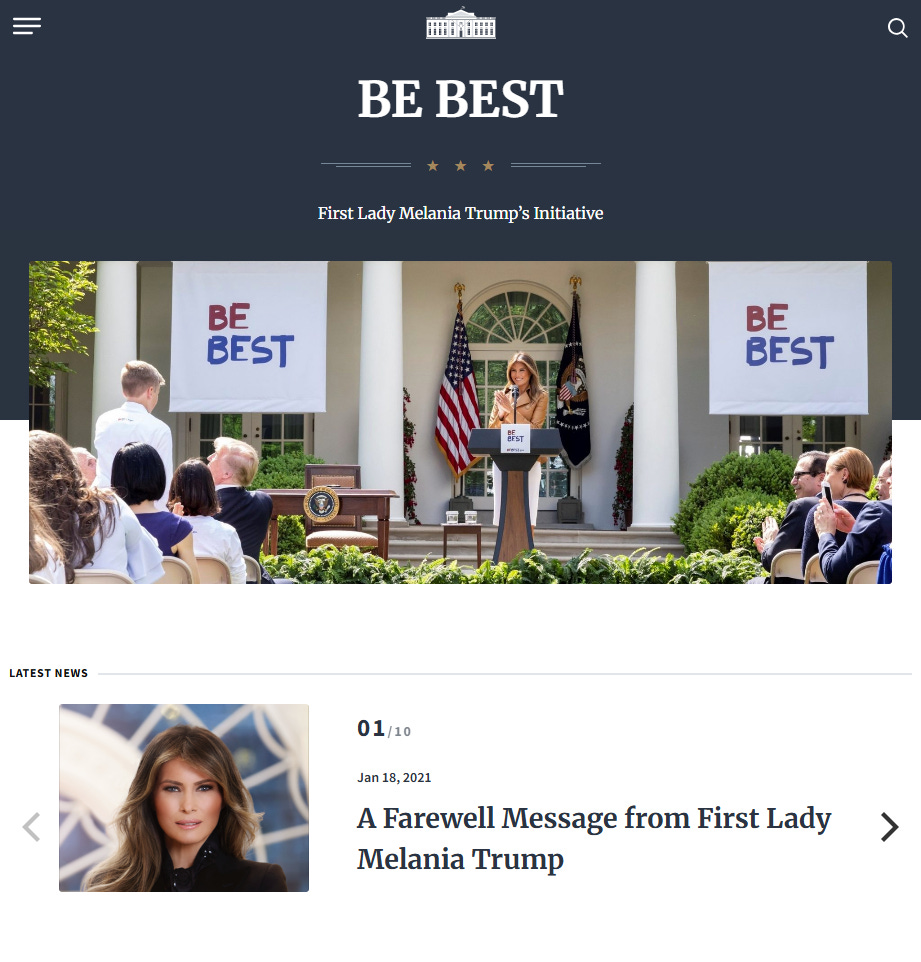
Anyway, that’s enough airbrushing and crimes-against-design for one newsletter. I mostly wanted to draw your attention to the word “best” and the assumption it quietly hides: That it is something we can measure.
As a 20th/21st-century human, you have undergone testing many times to determine your relevance, aptitude, suitability, status, or attention. You have been tested formally at school or at work, and informally on social media. You have been tested on your capability to operate in ways that are safe or effective, legally or culturally appropriate. You have been tested for the sake of yourself, or others around you, or your bosses’ and rulers’ gratification. You might have been subjectively observed or objectively benchmarked. It might have happened one afternoon, or over the course of years.
Testing is so mundane that we don’t really even think about all the ways that it is applied in our lives. And each time we are tested, the purpose is to measure something about us; to measure us against some standard. Meaning, there is invariably a way to ‘be best’.
It should go without saying that we haven’t always had this granular measurement in the human experience. There were presumably excellent ‘hunters’ and better ‘gatherers/farmers’ among early humans, and presumably some cultures incorporated testing-adjacent rituals to determine readiness to perform various dangerous activities. But exams on how to identify a safe foraged plant, or a performance review following a mammoth hunt, basically amounted to “did you die?” Maybe, with further introspection, “Did you contribute enough to helping the rest of us not die?” The idea of being your ‘best’ was secondary to the idea of achieving enough to have made the effort worthwhile. The modern us has abstracted that to a numerical score, which fails to acknowledge the social and communal components of it.
Importantly, the people doing those ‘doings’ actually understood that. They were sharply aware that, if their actions caused the poisoning or starvation of their tribe, that would be bad. For them as well. Humans generally have a very clear idea of what “good” looks like. While there are obvious exceptions—when measuring something subjective, self-interested, or stupid, or if we have no experience of the subject in play—we rarely have to be the best to deliver exceptional individual outcomes, because civilisation is a team sport, so contribution is actually where the magic happens. We even did the math to prove it.
What I’m getting at here is that, in many situations, our modern assumption is that ‘testing’ is required. But where a person understands what a valuable outcome is, we shouldn’t be trapped by more measurement being the only mechanism for producing it. That is true regardless of whether they are teaching, sporting, entertaining, inspiring, delivering profits, finding cures, improving society, and so on. If we don’t know what a valuable outcome is in a given situation, then that’s actually a failure of structure and leadership, not one of insufficient measurement.
What prompted the writing of this piece was a conversation I had about the expectation of being “observed” while doing a job, and about how often it just puts people on edge rather than empowers them to deliver. Being able to ‘turn up’ for an explicit test is just a very different skill from being able to consistently deliver the goods. And—related—for a lot of people, being able to deliver a consistently good output may well hinge on a feeling of autonomy and trust. In some respects, that is what we describe as being an “adult”: taking self-responsibility for delivery rather than having to be assessed.
Big picture, there is a way of getting consistent performance out of people. It doesn’t come from burdening them with tests; it comes from deciding what you’re prepared to allow their “worst” to be, and then supporting them up to that level.
I am not saying this is easy, and I appreciate that it ironically sounds like something one might actually achieve via testing and measurement. But the difference is mindset: You can be assured of that because, if you think about how hard it is to build a platform for consistently high performance, you’ll conclude it’s probably more expensive and harder work compared to simply measuring people with generic tests.
People vary in ability and suitability across every aspect of the human experience. Much as (deluded) education system strategists want us to believe, we cannot design a system to lift everyone to the same testable level of quality—unless we’re prepared for that level to be embarrassingly low. Because of that, we break all human contribution into atomised industrial processes, allowing us to instead fill a nice big spreadsheet with meaningless testable tasks, and find “efficiencies” within those narrow bounds. But that’s a terrible waste of human creative capacity. If someone is given fair and clear expectations, and the support structures (or perhaps self-supporting incentive structures) exist, to help them deliver to the level of their individual capabilities and through their individual pathways, testing (beyond a minimal baseline) becomes redundant. We license drivers to the level of safety; we don’t require them to be exceptional drivers before they can access our roads and use them in a way that best leverages their needs and talents. People find their own levels across a wide scope of specialisation, and, therefore, they can excel in ways that were not even conceivable to a tester who might want to box them in for the sake of that spreadsheet. On the other hand, if someone is constantly assessed, the best you can hope for is they get good at being tested, because they have no incentive to iterate beyond that.
I acknowledge there is some truth to the idea that “what gets measured, gets improved”, but I think there’s a simplistic sheen on it, mostly because it implies that something needs to be externally measured, or measured by someone else, rather than self-assessed and improved.
For a short time in recent history, the fastest growing companies actually did realise this. That’s why Google had free food and transport, rock-climbing walls, free project time, and generous equity options for developers. Obviously, not all of their developers were delivering the same output, and Google famously still used metrics to quantify outcomes, but understood that frictions like hunger, a distracted or restricted mind, or the fear that they were not valued, could tangibly stop their employees from delivering. The deliberate autonomy unlocked people beyond the realm of the test: inventing, creating, and finding new pathways.
I don’t think this aspiration is better summarised than in the first line of a well-known Irish blessing, framed on the wall of my Aunty’s hallway in my childhood memories, and sung in my high school choir:
May the road rise to meet you
The world doesn’t owe you a destination or the means of getting there. But—to the extent that civilisation and technology and society and law allow it—an equitable and effective world can smooth the journey by taking some of the weight out of each step.
Increasingly, this is no longer the approach we take to performance or innovation. Capital owners, and those close to them, look after themselves, because their job description basically amounts to “make the line go up”, which—it turns out—is no longer a collective enterprise. Measurement turns messy human achievement into something rankable, comparable and—by extension—controllable and ownable. Over the past decades, our economies have shifted to resource the people who get to decide what that line-chart is measuring, and they, in turn, squeeze that line’s trajectory out of the resources of the people who have to physically deliver it. We have come to believe success is about building a strategic measurement system, and that measurement happens through testing rather than good output.
This way of viewing merit represents an intrinsic way of protecting class and status structures. To bring it back to Melania Trump’s initiative, what if she succeeds? What happens to her…umm… “life’s work” if bullying actually ends? Without something to measure, there’s no reason to dress up all fancy and garble pronouncements from behind a crest-bedecked podium. We are building institutions that succeed through measuring the continued existence of problems they outwardly claim to solve. What would the police do with their armoured trucks and frag grenades if we didn’t have the kinds of compulsion and despondency that drive much of our crime?
How many managers, or administrators, or Chief [Whatever] Officers exist purely to test and measure a thing which their employees have a much better grasp of? And then to devise ever more convoluted ways to meet, discuss, report, and justify their own existence?
We should hope for a world of uncompromised social safety nets, with no patience for unnecessary suffering or disposability; a world that allows the best out of people without needing a spreadsheet or a boss to determine what that might look like. A world of roads that rise to meet each step, to flatten the hills regardless of the destination or the capability of the journeyer.
I write that with optimism that it might be possible. Under our current economic and social circumstances, it’s probably not. I am under no illusion that we will voluntarily give away the perception of advantage we grant ourselves by carrying on measuring each other. After all, there is (unsurprisingly) evidence that incentives can increase performance, simply because we can adjust our behaviour to match the stakes. If the stakes are a bonus, promotion, or other status signal, then many people may try harder and perform better. The question is, if the stakes are “achieve, or be fired/failed”, does that deliver us the same valuable outcome as “overachieve and share in the benefit”?
Which brings me to a double standard here. What makes someone “elite” in our present social construct is simply that they no longer have to be tested. They get lauded against standards they themselves can set, and get to decide how rewards are allocated. More importantly, they get to decide what the obligation on them is, to provide appropriate guidance and training, vs. what our obligation is to pass tests and measure up.
The kicker is that we might be about to find out what a world without this kind of measurement looks like anyway. What I’ve termed the “anticrisis”—the point where human effect is free of any meaningful friction—is a world that probably doesn’t need measurement. I can’t say for sure if, or when, we might reach this point, but it is a point that not only makes being the “best” a largely pointless pursuit, but also end-runs any benefit we get from incentivising performance or initiative.
And if you doubt that, you should consider the aspirational career of the Prompt Engineer. I’ll forgive you for not noticing—this all happened about 18 months ago after all!—but back in 2023, Prompt Engineering was a burgeoning career built on an optimal ability to command a large language model AI for effective and efficient results. Only, this “best” has essentially already disappeared, before we even had a chance to define it. It only took a matter of months before people realised AI could prompt itself better than a human could (and an alternative AI model could create prompts better than both!) It’s fair to say, this was possibly the first industry to genuinely succumb to “AI replacement”.
We hardly knew ye.
In a world where some variation on the singularity is either already here, or inevitable, or an existential risk, or even just a marketing gimmick—depending on your level of optimism about cultural technology—it’s very likely we’re going to need to move beyond a meritocratic world. There are lots of ideas on how we might achieve this—I’ve written a bit about things like Universal Basic Incomes, the virtues of working together, and how we might decode the social implications of AI—but the hierarchical imperative to test us is a sticky problem.
Which is all to say, maybe it’s time to allow the era of a measurable “Best” to quietly slip away again, and rediscover contribution.
-T