
My inflated ideals
On useful pain

I’ve mentioned this simple inflation calculator in the past.
Money - productivity = inflation
I was thinking about this recently because, for the past few years, governments worldwide have been struggling to really get inflation under a broad kind of “control”. That is, they might be able to get their list of priced commodities into some arbitrary range, but it’s happening without much buy-in from their citizens on the ground. Increasing numbers of us are experiencing a practical reality where the price of just living a ‘pretty ordinary life’ is increasing in a way that just is detached from the ability to earn a commensurate income.
Now, I should point out I’m not trying to sell you on some theory about inflation being caused by ‘consumer expectations’. But there’s no doubt that all this talk of inflation in the media does provide a convenient, pre-packaged excuse for any profit-taker who needs something to point a finger of blame at other than their own greed!
Inflation is not bad.
It does an important thing for successful capitalism: it encourages one to spend dollars today rather than wait to spend them tomorrow and, more importantly, it encourages that spending to be productive enough to offset the effective-devaluing of money that inflation causes. In essence, inflation is the process by which each dollar progressively buys you less stuff if not acted with. So, it makes saving money less appealing and, in our debt-driven economies, it also reduces the risk of borrowing because—provided your income grows in parallel with inflation—the extra dollars you have in the future are going to offset any interest costs.
So, if you buy a chest of gold coins today, you’ll get the benefit of handing over fewer physical dollars than if you buy the same chest next year (assuming inflation). And, if you borrow those dollars from a friend, you’ll ideally have also had an inflation-accommodating wage rise by the time you need to pay it back.
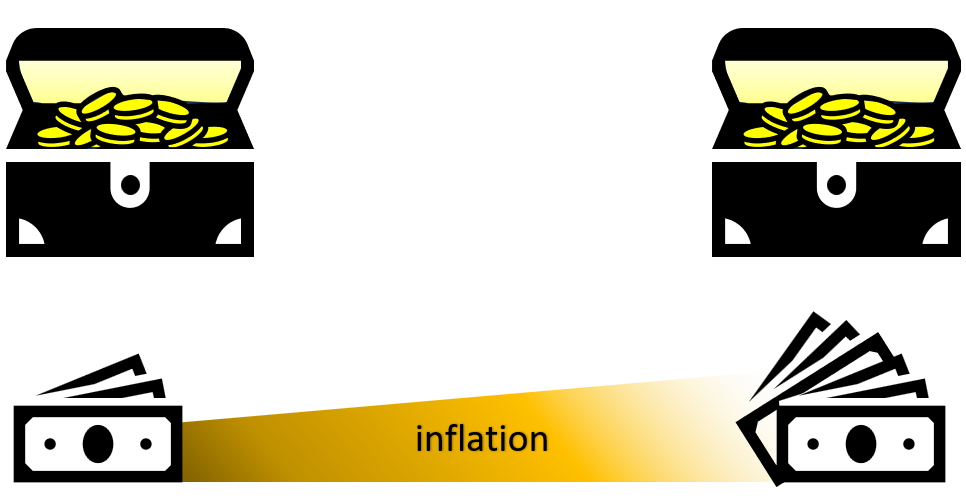
However, inflation requires some coordination. You can’t just increase the price of things without increasing the wages of an ordinary person, because the economy would flounder as it runs out of consumers. You also can’t just increase wages or debt or money-printing without being able to leverage it into improved productivity—that’s how the Allies confiscation of the (highly-productive) Ruhr Valley industrial area after WW1, while still demanding monetary reparations, led to Weimar’s infamous hyper-inflation in the 1920s.
This is all to say, trying to address inflation exclusively with tools like Central Bank interest rate changes is severely limited. Especially once you appreciate how often, in the past 50 years, interest rates have been used to deliver depressingly-shallow benefits to our economies, via house price rises, finance-sector profits, and raising unemployment in a bid to reduce union power.
So, in the shadow of that, is this idea that the benefits of inflation “work” (as described above) only when the economy around it is growing pretty evenly. If certain essentials are doing most of the inflating, the whole incentive is bunk.
100 years on from Weimar, much of our cost-of-living-a-reasonable-life inflation remains centred around things like housing, healthcare, education, and energy; basic stuff that we probably should have worked out how to provide in a communally-beneficial way by now. So, in spite of the irrationality of forever inflating the price of ‘essentials’ while 4K HDR TVs continue to drop in price, it is to essentials that the inflation-fearing money is gravitationally drawn. If you’re a capitalist and the price of TVs remains static or dropping, you’re unlikely to go rushing out to buy a TV factory… Certainly not when you could use your (deflating-value) money to buy an old house which keeps going up in price.
Which is all to say, that’s why the politicians are not having much luck with controlling their inflation messaging.
This problem is especially apparent in one of my long-moans, housing, which—in most cases—grows in value even as it ages in condition. This is not productivity of course, it is scarcity. A large old house near good transport links and shops and workplaces that is not being turned into multiple modern units, is the very definition of unproductive.
Yet, capitalists and their politicians love house price inflation. We taught to yell and scream about the price of bread or butter rising, as politicians wrap themselves in knots justifying the ‘wealth effect’ of housing inflation. Why do we worry so much about rising mortgage interest rates or land taxes when, as high as they get, they’ve still historically lagged behind the growing value of simply owning land? Why are there not cries when a Central Bank lowers their benchmark interest rate that it is a “subsidy” for those privileged enough to have a mortgage? Why wouldn’t a kid, upon noticing wages have, for decades, not kept pace with the inflated cost of a “reasonable” modern life (including an occasional smashed avocado on toast), not notice their parent’s house has dramatically inflated in value, and just check-out from life until their inheritance arrives?
Re-educating our political leaders and their economic advisors about how inflation should work has proven a long-term challenge. I think this is captured in something about that formula which was neatly encapsulated in John Maynard Keynes’ famous proclamation that “Anything we can actually do, we can afford”. Both money and productivity are on the same side of the ledger because that’s where ‘the economy’ happens. Literally, in an economy, improving productive outcomes is inverse to the amount of money mattering.
Even though Keynes realised this 100-odd years ago, our economic understanding still hasn’t caught up. For example, it proves a modern fiat government (which most of you live under) absolutely can just keep printing money and—provided it is used productively—it will not cause any inflation because, as that formula makes clear, there is only a cost to creating money if it doesn’t improve productivity.
However, with the hazy edges of private and public economics now, we tend to forget that money matters in a very different way to the private sector. They look at that formula and conclude “if we can cause inflation (increase our prices), without spending to improve productivity (monopolisation, underinvestment, wage suppression), we can increase our money-profits!”
Price (money) - production cost (productivity) = Profit margins (inflation)
Hence, the less they have to spend on productivity, and the more social licence/autocracy they have to increase prices, the better! If you’ve tried to buy eggs in the USA in the past couple of years, you’ll be familiar with this ‘one weird trick’
What we need to realise is, the mandate of a government should be to determine not an amount of inflation, but rather the right amount of inflation. Their job—as the money supplier—is to understand that money is fuel for the economy, meaning the amount is less important than whether an engine is available to efficiently burn it. That engine is built on collective infrastructure, education, healthcare and so on, which the private sector can leverage. It is not—as a general rule—built on tax cuts, privatisation, or subsidies that make the private sector more profitable. And it is certainly not built on allowing billionaires and vulture capitalists being allowed (and encouraged with tax policy) to buy up existing houses and brands, not with any intention to improve them but rather simply run them down as equity to leverage more debt and profit.
Inflation has a particular way of progressing us under capitalism and we need to accept its limits.
Let me leave you with a little info tidbit to illustrate how this works:
If you had US$100 in 1925 and purchased some gold with it, the 4.84 oz of gold you purchased (@ the fixed rate of $20.67 /oz) would now be worth US$16,123 (using today’s gold spot price of $3331.32 /oz).
No bad compared to consumer price inflation (in the USA) over that same period, which means you’d need around US$1800 to buy the same basket of (non-gold) goods in 2025 as your $100 would have bought in 1925.
So, with that insight, gold appears to be a pretty good buy.
Where it gets interesting though is that we could have done other things with the money. For example, to test if (mathematical genius) Albert Einstein really believed compound interest was the world’s “eighth wonder”, we could have put that $100 into a savings account and received the historical-average 3% interest available since 1925. Compounded over 100 years, your savings would still have just barely covered the inflation burden, reaching just over $1920 by 2025.
Probably less than you thought, given how powerful we keep getting told compound interest is. So, instead, we could have put the economic leverage that inflation can offer to the test: If we’d managed to get our $100 into the equivalent of a S&P 500 indexed share fund (with reinvested dividends) over the same tumultuous period, it would be worth just over $2.1m by now! That’s what a century of inflation incentivising productivity can be worth.
Which is all to say, there is genuine power in inflation. The threat of it; the way it discourages savings and encourages productive spending; the way it reduces debt burdens. It’s clear those things can generate growth with sensible application. The outstanding question we should have then is, are we doing enough to ensure the shared ‘pain’ of inflation is not just leveraged for the good of people who have money invested in houses and shares, corporate moats and politicians, but rather this useful pain benefits us all.
It shouldn’t be feared, but we do need to fight hard for who it serves.
-T
Interesting. Thanks, Tim. ...Of course, you could now have used the NZ butter price vs US eggs!!!