
Siege mentality

It’s slang whose time came and went—for good reason—but, back when I was a kid, it was common to describe someone as “mental” when they were being excessively illogical, erratic, or ferocious, as in “far, dude, that’s mental!”
It drifts dangerously close to sounding ableist now, of course. I guess it might be the equivalent of something like “skibidi”, “feral”, or “cooked” if you’re a young, hip thing. A generation before me, those sorts of feral acts might have been described as “going ape”, “freaking out”, or “kooky”.
The fact that every generation has slang for behaviour that recognisably breaks away from norms and reason suggests that behaving erratically is both a very normal emotional or social dysregulation, and it means we’ve developed a technology—language—to empower people around you to correct it in an acceptable and effective way. We might behave like this to attract attention when we’re feeling a bit unnoticed, or when we just need to expend some excess energy, or to distract from other moods or fears, or even to express joy and love.
The reason these somewhat ‘chidish’1 words exist at all is that we can foresee consequences, so we use them as a soft way to subdue unhinged behaviour, for our own sake, for others, and for the “feral” people we love.
In the (lumpy) Western political hemisphere, we generally use bureaucratese in place of slang like skibidi. We “sanction” “failed states” and use “diplomacy” for “regime change”. Still, the scaled-up reality is not as different from the playground as we might pretend.
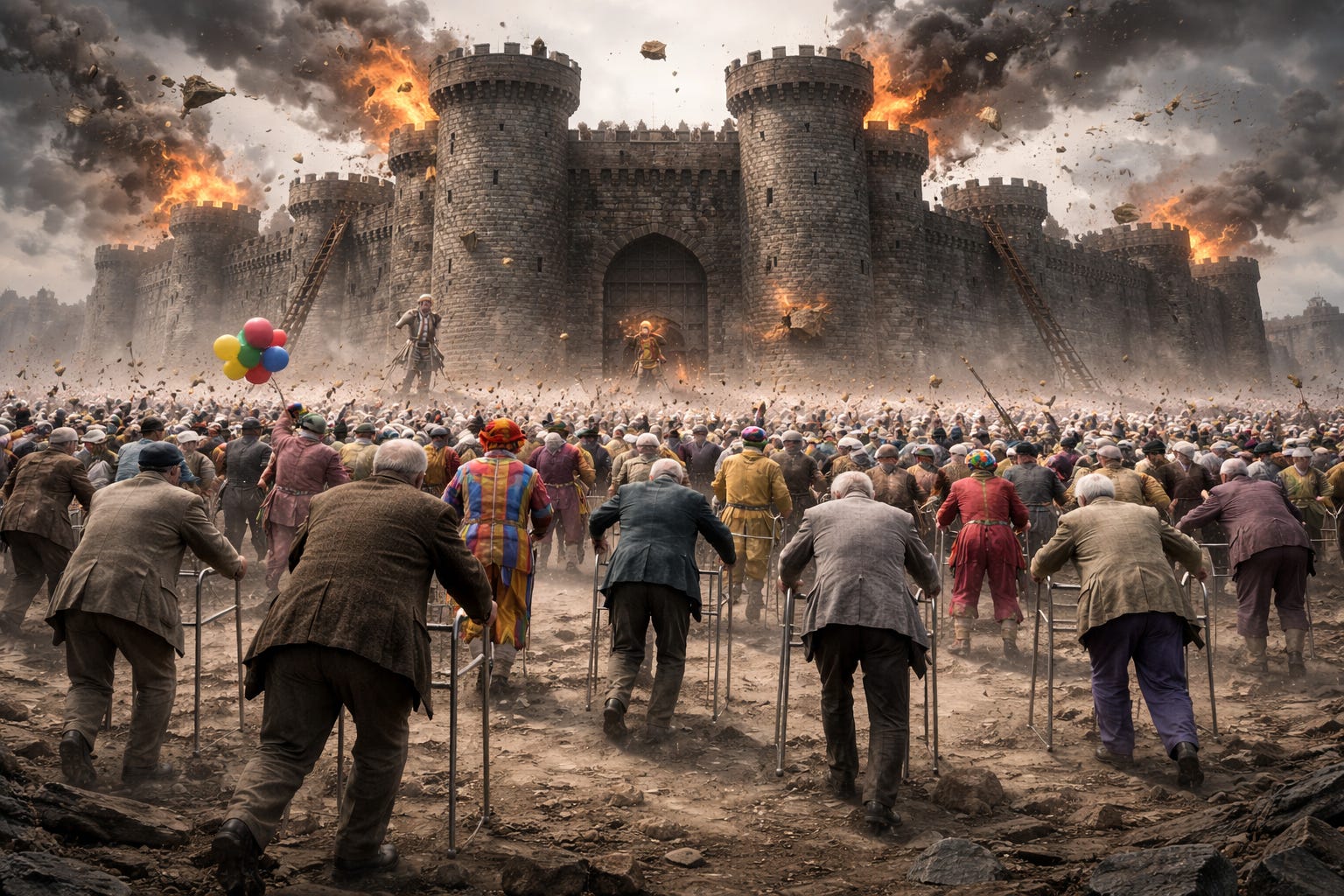
A few centuries back, what we now describe as “sanctions” on global trade would have been described as a “siege” on an enemy’s fortress. When fortresses were built, they were intentionally designed to make an assault by your enemy either prohibitively costly or impossible. So a pragmatic attacking army would instead surround the area and block supplies from entering or leaving the city until—all going to plan—the fortress-dwellers would surrender through hunger, or perhaps revolt against their rulers once the waste-disposal options start getting revolting. In reality, the heat that stirred the conflict in the first place generally meant that the attacking army would rush in, swords-a-swinging, and a siege would happen after an initial assault; the offensive army would attack, suffer a bunch of early losses, and then conclude that this is not going to be the ‘walk in the park’ they had hoped for. Only then would they settle in for a long blockade to try and turn their enemy desperate. The trick to it, though, is that if even your siege hasn’t achieved that goal after 47 years, you should probably not go back to just hurling soldiers and military spending into the impenetrable walls of the fortress.
That would be mental!
-T
I’m not actually sure this is a real word! It is not a “childish” typo, however. To ‘chide’ someone is to scold them.